

Sash Pulleys: How They Wear, Squeal and When to Replace Them
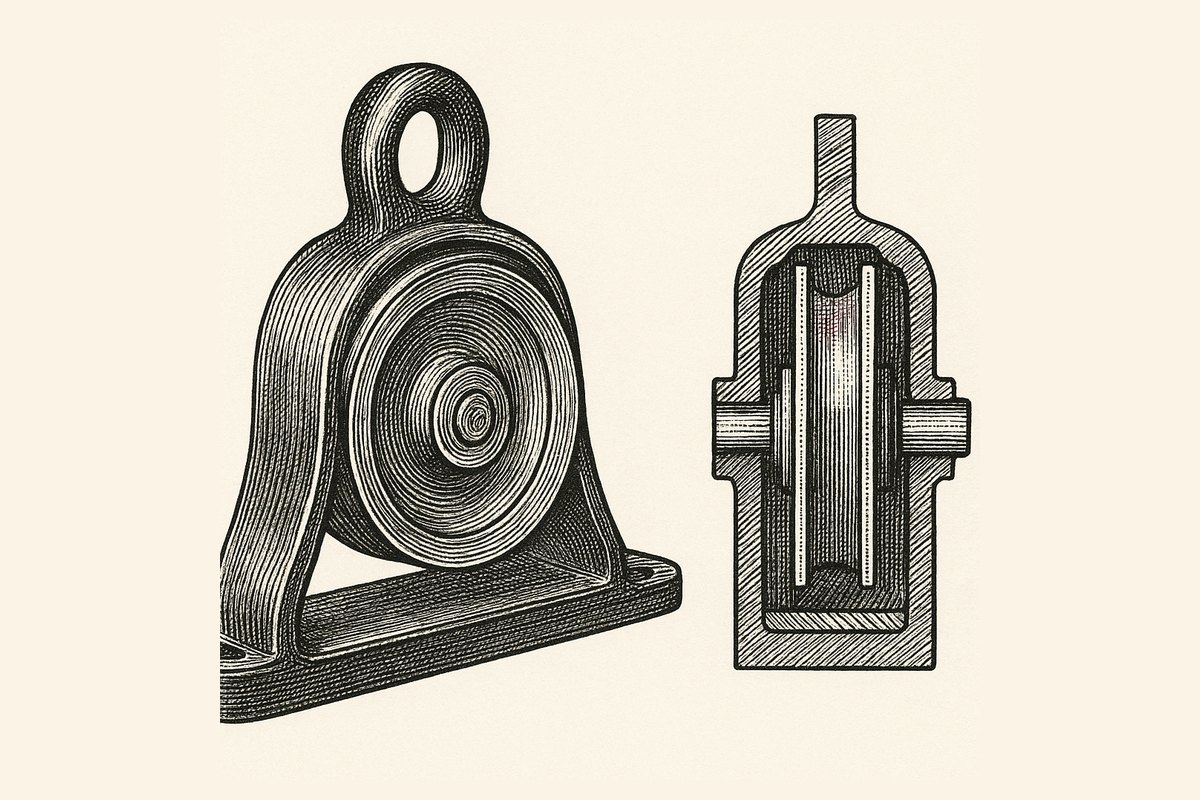
The squeal is the giveaway. A sash that shrieks on the way up, or needs a shove to get going and then runs freely, or eats a new cord within a couple of years, is telling you the same thing four different ways: the pulley wheels have stopped turning. The cord is no longer rolling over them. It is sawing across them.
That is a small fault with an expensive consequence, because every cord in the house is now wearing at four or five times the rate it should. All of it happens out of sight, inside the pulley stile, which is why a squealing sash usually gets lived with for a decade before anybody takes a bead off to look.
What the pulley is and what it carries
The proper name is the axle pulley. It is a wheel running on a steel spindle, held in a pressed or cast body, with a slotted faceplate that is let flush into the top of each pulley stile, usually 100mm to 150mm below the head of the frame. There are four of them in a standard box sash: two for the upper sash, two for the lower.
Wheel diameters here have settled on two common sizes. 1¾ inch, about 44mm, is the common one and fits most Victorian and Edwardian sashes. 2 inch, about 50mm, turns up on larger, heavier windows. You will occasionally meet 2¼ inch on a big Georgian sash carrying plate glass.
What the wheel carries is the tension in the cord, which is the weight hanging in the box on the other side. On a typical London sash that is somewhere between 4 and 9 kilos a side, depending on the glass. Plate glass, later Victorian, is much heavier than early crown or cylinder glass, which is why two windows in the same house can have very different weights in them. The wheel takes that load continuously, whether the window is opened once a day or once a decade. Our article on how a sash window works sets out the whole balance if you want the mechanism rather than the fault.
The load is not the problem. A 44mm wheel on a steel spindle will happily carry 9 kilos forever. What kills a pulley is what surrounds it.
Why they seize
A sash pulley spends its life inside a hollow timber box built into a solid wall, with no ventilation and a cold outer lining. In a London winter that box runs damp. Now put a steel spindle through a brass or a galvanised steel body and add moisture, and you have made a straightforward corrosion cell. Steel and brass in contact, with an electrolyte, is a battery, and the steel is the part that gives up.
The result is rust building on the spindle where it passes through the body, packing the clearance and eventually locking the wheel. It is slow, invisible from the room, and essentially universal on any window that has not been touched in fifty years.
Three other things join in.
- Paint. Decorators paint the faceplate and, worse, run the brush across the slot. Paint hardens between the wheel rim and the plate and stops the wheel dead.
- Old grease. Whatever was put on at manufacture has oxidised into a brown varnish. Grease attracts dust; the mixture sets like a soft glue.
- Cord dust. Waxed cotton sheds fibres and wax into the wheel groove. Over decades that builds into a hard rim, so the cord no longer beds properly and rides high.
What the squeal actually is
Once the wheel stops turning, the cord still has to get from the sash into the box, so it drags across a stationary wheel. That is stick-slip friction: the cord grips, tension builds, the cord releases, hundreds of times a second. The noise is the cord and the wheel rim vibrating against each other.
Two consequences follow, and they are why this matters more than a noise nuisance.
The cord wears out. A sash cord already fails at one specific place: the few centimetres that sit over the pulley when the window is shut, because that is the only point on the run where the rope bends around something and straightens again on every operation. A seized wheel adds pure abrasion to that flexing. A cord that should give you thirty or forty years gives you five.
The wheel wears out. A stationary wheel gets a groove worn into one spot of its rim, always on the same side. When it eventually frees off, that flat runs against the cord once per revolution and the cord picks up a bruise at the same interval. A pulley with a worn flat is finished, whatever you do to the spindle.
Never replace sash cords without checking the pulleys while the window is open. Fitting new cords over seized wheels is the most common false economy in this trade, and it means dismantling the same window twice inside a decade.
Testing a pulley without taking the window apart
Five checks, in order of how much you have to dismantle.
- Listen. Raise and lower the lower sash slowly through its full travel. A sound pulley is nearly silent. A dry one chirps. A seized one gives a sustained squeal that changes pitch with speed.
- Feel for the sticking point. A window that needs a firm shove to start and then runs sweetly is almost always seized pulleys rather than paint. Paint binds the whole travel; a seized wheel binds at the start, when you have to overcome static friction to make the cord slide.
- Look at the cord where it meets the wheel. Close the window and look at the exposed cord on the outside of the stile, just below the pulley. Furring, a flattened section, or a bright polished patch means the cord has been sliding rather than rolling.
- Spin the wheel. Take the staff bead off, swing the lower sash into the room and rest it on a cloth. Put the tip of a screwdriver into the wheel and spin it. A sound pulley turns easily and coasts for a moment. A dry one turns with resistance and stops immediately. A seized one does not turn at all.
- Check the faceplate. Run a fingernail down the edge. If it is buried under paint, the wheel almost certainly is too. Score the paint line before you try to lever it, or you will take a chunk of the pulley stile with it.
If the window will not move at all rather than moving noisily, the pulley may not be your fault. Work through the sequence in our piece on the stuck sash window before you commit to buying anything.
Oil, or replace?
Honest answer: oil first, and expect it to work about half the time.
Use a drop or two of light machine oil on the spindle each side of the wheel, work the wheel by hand or run the sash a dozen times, and wipe the excess. Sewing machine oil is ideal. What you should not use is WD-40, which is a water dispersant and a solvent first, and not a lasting lubricant. It will free a wheel for a fortnight by washing out whatever old oil is left, and then leave the spindle drier than it was. Grease is no better: it does not reach the spindle and it collects dust.
Replace the pulley when any of these is true.
- The wheel will not turn after oiling and working.
- The wheel turns but has a visible flat or a bright groove worn into one part of the rim.
- The wheel wobbles on its spindle, which means the rivet has worn.
- The wheel is nylon and has gone brittle, or the rim has cracked.
- The cord groove has a hard ridge of wax and fibre that cannot be scraped out.
The economics are not close. A pulley costs a few pounds; getting at it means beads off and sashes out, and that costs an hour. Do it while the window is already open or pay for the hour twice.
What to buy
| Type | Rough trade price each, ex VAT | Where it belongs |
|---|---|---|
| Nylon wheel, pressed steel body | £1 to £3 | Budget work, rear elevations, light sashes. Quiet when new; the wheel is the weak point |
| Brass wheel in a galvanised body | £2.50 to £3.50 | The sensible default for most repairs. Brass rim runs well on cotton cord |
| Solid brass faceplate, ball-bearing wheel, 1¾ inch | £3.50 to £5.50 | Where the faceplate is visible and the window is used daily. Ball races genuinely last |
| Solid brass faceplate, 2 inch | £7 to £8.50 | Heavy sashes, large Georgian windows, anything with plate glass |
Three details that decide whether a new pulley actually fits.
Faceplate ends. Original faceplates come with square ends or radiused ends. Buy the wrong one and you have either a gap at each end of the mortice or a plate that will not sit in it. Match the old one before ordering four.
Faceplate length. The trade sizes a pulley by its wheel, not its plate, and plate lengths vary between makers. A new plate 3mm longer than the mortice means chiselling the housing on all four, which is fine but adds time. Measure the mortice, not the wheel.
Screw length. The pulley stile is thin, and the weight box is behind it. A screw that is too long will foul the weight on its way past and you will hear it knock every time the sash moves. Use screws that stop within the stile.
If you are buying pulleys you are almost certainly buying cord at the same time, and the choice there matters just as much: our guide to sash cord types covers waxed cotton against nylon and which diameter suits which window.
Replacing a pulley, in sequence
This is done with the sashes out, so in practice it is done as part of a cord job.
- Score the paint line along the staff bead with a sharp knife, then lever the bead out from the middle rather than the ends. Keep the beads and mark them; they were cut for this window.
- Take the lower sash out, cut its cords, and lower each weight gently to the bottom of the box.
- Draw the parting beads out of their grooves. They are a friction fit, no nails and no glue. Grip the middle with pincers and pull straight towards you. Then take the upper sash out the same way.
- Score the paint around each pulley faceplate, then back out the two screws. Old slotted screws are usually seized; get a proper hollow-ground driver into the slot and shock it with a light tap before turning, or you will chew the head.
- Ease the plate up with a thin blade under one end. If it will not lift, the paint bond is holding it; run a knife around again rather than levering harder.
- Clean the mortice. A hundred years of paint and cord dust will have shrunk it. Pare the housing so the new plate sits dead flush with the face of the stile. A proud plate will catch the sash stile and wear a shine into the paint within a season.
- Fit the new pulley, screws snug rather than crushed, and check the wheel spins freely with the plate tightened. Overtightening a pressed body can pinch the wheel.
- Rehang the upper sash first, then the parting beads, then the lower sash, then the staff beads.
The full cord sequence, including cutting lengths and setting the balance, is in our step-by-step on replacing a sash cord. Getting the balance right afterwards is the part that decides whether the window feels good: if it drops when you let go at waist height, the weights are wrong, and the fix is set out in our piece on sash weights.
The timber around the pulley
While the plate is out, look at the stile. Two problems are common and both are cheaper to catch now.
The mortice for the pulley is a hole cut through a thin board, and it is a natural weak point. Splits running down from it mean the stile has been flexing, usually because a sash has been running on one cord. They are repairable with a glued and cramped joint while the window is open, and not repairable at all once the beads are back on.
The other is decay at the base of the pulley stile, below the pocket, where water tracks down the inside of the box from a failed cill. SPAB's guidance on wood windows sets out the standard repair: cut the decayed section out and, where the pulley stile is not housed into the linings, run a hacksaw blade down between lining and stile to cut through the nail fixings, then glue and wedge a new section of pulley stile into the rebate in the cill before pinning the linings back with non-ferrous fixings. It is proper joinery, and worth doing rather than filling.
What it costs, and when to call someone
Expect around £15 to £40 per pulley on top of a cord job in London: parts plus the ten minutes each while the window is already open. On its own, a visit to replace four pulleys in one window is closer to £180 to £300, because you are paying for the dismantling rather than the pulleys.
Do it yourself if the window is on the ground floor, the beads come off cleanly, and you are comfortable handling a sash that weighs as much as a full suitcase. Call someone if the window is in a bay, above head height over a stairwell, or if the sashes are large enough that you would not want to hold one at arm's length.
We do sash cord replacement with new pulleys, parting slips and a proper rebalance as one visit rather than three, and the wider sash window repair service covers every London borough. If a pulley is squealing, it costs you nothing to test it with a screwdriver this weekend and find out whether you have a five-minute job or a morning's work.
Need this doing? We handle sash cord replacement across London — see our sash window repair service or request a free estimate.