
Sliding Sash Windows: How They Work and What Goes Wrong
A sash that will not stay where you put it. One that rattles all night when the wind comes from the west. One that takes two hands and a shoulder to shift. Those three complaints account for most of the calls we take, and all three come back to the same small mechanism hidden inside the frame.
Once you know what that mechanism is doing, you can usually name the fault without a ladder and often without leaving the room.
What is moving, and what is holding it up
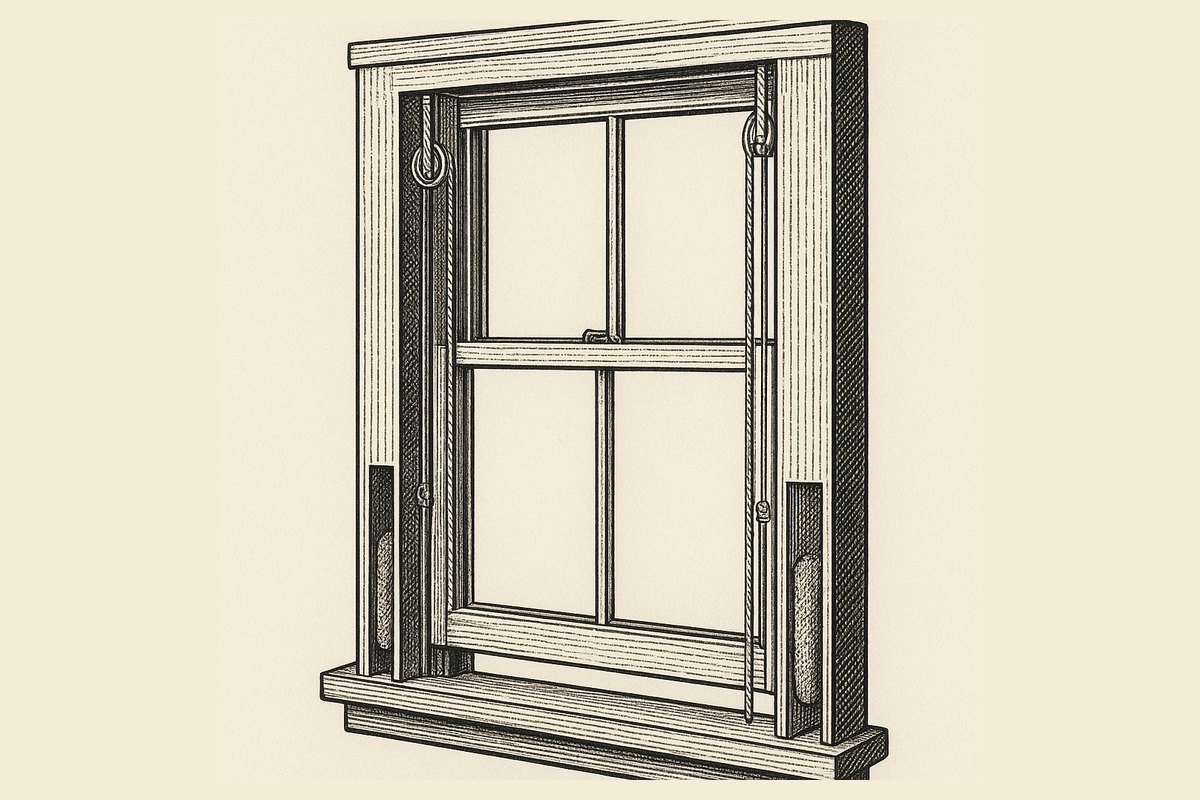
A sliding sash window has two glazed frames — the sashes — running vertically past each other in one opening. The lower sash sits on the room side, the upper on the outside, and a thin timber strip called the parting bead keeps them in separate tracks so they never touch. Push one up, pull the other down, and the window is open at the top and the bottom at the same time.
There is no handle, no spring and no stay because there does not need to be one. Each sash is tied by a cord at both top corners. The cord runs up the side of the frame, over a small wheel let into the head, and down inside a hollow box built into the thickness of the wall, where it carries an iron or lead weight of roughly half the sash's mass. Sash and weights cancel each other out, so the sash effectively weighs nothing in the hand and stays wherever you leave it.
Not every sliding sash works this way. From the 1960s onwards, spiral spring balances in a tube screwed to each side of the opening replaced the whole arrangement: no box, no cords, no pulleys, and a considerably shorter life. We go through the variants in our guide to the different types of sash window. If your window is in a Victorian or Georgian London house, it is almost certainly a box sash with weights.
Why the two sashes are not weighted the same
Start with the arithmetic. Take a typical Victorian two-over-two lower sash, say 900mm by 700mm, glazed in 4mm float. Float glass weighs about 2.5 kg per square metre for every millimetre of thickness, so the glass alone is a little over 6 kg. Add the timber, the putty and forty years of paint and you are somewhere around 11 or 12 kg. Split that between two weights and each one is 5 to 6 kg. Across most London houses the range is roughly 4 to 9 kg a side, and it climbs sharply the moment somebody puts sealed units into an original sash.
The counterweighting is deliberately not exact, and this is the part most people miss. The bottom sash is weighted a shade light, so it settles rather than creeping upwards and pulls itself down onto the cill. The top sash is weighted a shade heavy, so it stays up instead of sliding down under its own mass and sitting half open on a wet Tuesday. A few hundred grams either way is all it takes, which is why top and bottom weights are not interchangeable.
Swap them in a past repair and the window misbehaves in a very specific way: the top drifts down, the bottom drifts up, and the two meet in an untidy stalemate. Our piece on working out the right sash weight covers how to weigh a sash and match iron to lead.
Rule of thumb: raise the bottom sash about a foot and let go. A correctly balanced sash holds within about an inch. If it slides down to the cill, a cord has gone or the weights are far too light. If it climbs on its own, they are too heavy.
The cords, the pulleys and why cords always break in the same place
Traditional sash cord is waxed cotton, sold by number. No. 6 is roughly 8mm and suits lighter sashes; No. 8 is roughly 10mm and goes on the heavy ones. The wax is not decorative. It keeps the cotton from drinking moisture and stops the strands abrading each other as the rope bends, and that bending is the whole story of cord failure.
Cords fail at the pulley end first, almost every time. That is the one point where the rope flexes over a wheel on every single movement of the window, and cotton fibres that bend repeatedly in the same place break there. The rest of the cord can look perfectly sound while the last 200mm has gone to fluff. When one cord goes, the other three are the same age and have done the same work, which is why a joiner replaces all four. The cost is in taking the window apart, not in the rope. The full sequence, pocket to parting bead, is in our guide to replacing sash cords.
The parts around the cord are worth knowing by name before anyone quotes for work on them. The complete list is in our glossary of sash window parts; these are the ones that decide whether the window moves.
- Pulley stile. The vertical board each sash slides against. Nearly all the wear happens here.
- Axle pulley. A wheel, usually 44mm to 50mm across, brass or nylon, on a steel axle in a faceplate screwed flush into the stile. It should spin silently under a fingertip.
- Parting bead. A strip roughly 8mm thick and 20mm deep, sitting in a groove in the stile and holding the two sashes apart. A friction fit, not glued, so it can be prised out — which is how the top sash comes out.
- Staff bead. The moulded strip on the room side that retains the bottom sash. First thing off in any repair, and the part painters most reliably glue shut.
- Pocket piece. A removable panel low down in the pulley stile, usually invisible under paint, through which the weights are lifted out.
- Parting slip, or wagtail. A loose strip of about 6mm hanging inside the box between the front and back weights so they cannot collide. A missing wagtail is the commonest cause of clattering inside the frame.
- Meeting rails. The two rails that close together in the middle, cut with matching bevels so the fastener wedges them tight. Worn bevels mean a rattle and a fastener that will not pull up.
Reading the fault from the symptom
| Fault | What you notice | Underlying cause |
|---|---|---|
| Paint seizure | Window will not budge at all | Repeated overpainting bridging sash to staff bead and parting bead |
| Broken cord | One sash drops, or sits crooked and jams | Cotton fatigued where it bends over the pulley wheel |
| Worn pulleys | Squealing, or a jerky, stiff slide | Dry or corroded axle, or a wheel worn oval by a frayed cord |
| Rattle | Noise in wind, draught at the middle | Shrunken sashes, worn meeting rail bevels, missing wagtail |
| Rotten cill or bottom rail | Soft timber, flaking paint, blown putty | Standing water on horizontal surfaces, failed paint film |
| Out-of-balance sash | Creeps up or drops when released | Mismatched weights, heavier glazing added, stretched cord |
Paint seizure deserves a note of its own, because it is the great London fault and the one most often mistaken for a window that has had it. A sash has to slide within a millimetre or two of clearance. Sixty years of gloss brushed carelessly across the joint between sash and bead closes that gap completely. Nothing is damaged and nothing is worn out; it is a maintenance failure and it is entirely reversible. Our article on diagnosing a stuck sash separates paint from swollen timber from a snapped cord.
Five checks before you ring anybody
- Look at the middle. Is the fastener pulling the meeting rails tight together, or is there daylight between them? A gap here means the sashes have shrunk or the bevels have worn, and it is the main source of both draught and rattle.
- Lift the bottom sash and let go. Holds within an inch: the balance is fine. Drops: cord or weight problem. Climbs: over-weighted.
- Listen while you move it. A squeal is a dry pulley. A grinding rumble is a weight rubbing the back of the box. A clatter as the sash passes halfway is a missing wagtail.
- Press the bottom rail and the cill with your thumb. Sound timber gives nothing. If your thumb sinks or the paint dimples, there is wet rot underneath and it has to be cut out before anything else is done.
- Run a blade along the staff bead joint. If a craft knife will not part it, the window is painted shut and the fix is mechanical rather than structural.
Those five answer most of it. What they cannot tell you is the condition of the timber inside the joints, and that is what actually decides repair against replacement.
Why so many London houses still have them
The oldest counterbalanced sash anyone has found in this country is not in London at all. It is at Palace House in Newmarket, what survives of the lodging Charles II bought in 1668 and had built by William Samwell, and the window is dated to about 1671. It spent most of two centuries sealed behind brickwork and only came to light during restoration in 1996. It is not quite the window in your wall: those lower sashes were counterbalanced on one side only, by lead weights strung along a single cord, with no box and no wagtail. Hang a sash on one corner and the load is off-centre, so it tries to rotate and binds — exactly what a modern sash does when one of its four cords snaps. Two cords, one at each top corner, pull it square, and once that was settled the design barely changed. Samwell's rebuilt south front at Ham House in Richmond carried what was probably the first large installation of them in an English house.
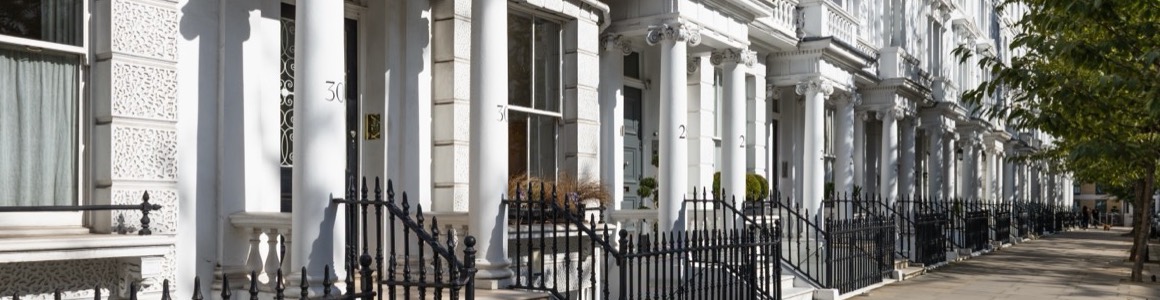
London took to the sash harder than anywhere else for practical reasons rather than architectural ones. The city built in brick, in terraces, at enormous speculative volume, and a solid brick wall is thick enough to swallow a weight box where a timber-framed or stone one is not. Joinery standardised early, so a builder could order sashes by the dozen and fit them by the street. The window also suits an urban room: opening top and bottom together vents warm stale air out at the head while drawing cooler air in at the cill, which no casement of the same size does as well. And a box sash is repairable by design — cords, pulleys, beads and putty are consumables, meant to be replaced several times over the life of the window, and the frame is built into the wall and usually the soundest part of it. Sashes were still going into London houses as standard in the 1930s.
Where the Building Regulations actually bite
This matters because it changes the price and the paperwork. Overhauling a window you already have — re-cording, new beads, re-puttying, draught seals, splicing a rotten rail — is not the provision of a new controlled fitting under Approved Document L. There is no energy target to hit and no FENSA or Certass certificate involved. Replacing the glass within an existing frame is treated the same way.
Fit whole new windows and it changes. The limiting standard for a replacement window in an existing dwelling is 1.4 W/m²K, or Window Energy Rating Band B. That standard is not absolute, though, and on a period London street the exception matters more than the rule. Approved Document L exempts listed buildings, buildings in a conservation area and scheduled monuments from full compliance where meeting it would unacceptably alter the building's character or appearance. It is not a blanket pass: you are still expected to comply as far as is reasonably practicable, and the local authority conservation officer's view carries real weight with building control. That carve-out is why slim-profile units and secondary glazing turn up so often in conservation-area schemes. What applies depends on your building's designation, so check with the council before anyone orders glass, and read our guide to what the Building Regulations require when you repair or replace a sash.
Replacement genuinely makes sense in a narrow set of cases: where the box frame has rotted through at the cill and back lining and the wall is wet behind it; where a previous owner butchered the frame to take a uPVC insert and the original detail is gone; or where the sashes carry more filler than timber. Be suspicious of a quote that reaches that conclusion in under ten minutes, and particularly of one that reaches it for every window in the house.
What to fix first
Order matters more than most people expect, and getting it wrong means paying twice.
- Rot, before anything else. New paint over soft timber buys you a season. Cut it out, splice in sound timber, then decorate.
- Cords and pulleys next. This is what turns a window you fight into one you open with a finger, and it is usually the cheapest structural improvement available. Most houses need new cords and pulleys long before they need anything more serious.
- Beads and meeting rails. Worn bevels and a shrunken staff bead are the rattle and half the draught.
- Sealing, once it moves properly. Draught-proofing a seized sash is money thrown away, but sealing a window that runs freely is the single best return on a period window.
- Decoration last, when the joinery underneath is right.
When you do get someone in, ask for the fault named rather than the remedy. "The cords have gone on three windows and the bottom rail on the front bay is soft" is a diagnosis you can price and phase. "Your windows are past it" is not. Our sash window repair service covers cord replacement, overhaul and draught-proofing across the London boroughs, and whoever you use, insist they open the window fully before quoting. Anyone who prices a sash window without sliding it has not looked at it.
We repair and restore timber sash windows across London — see our sash window repair service or request a free estimate.