
Slimline Double Glazing for Sash Windows: The Real Trade-Offs
A quote has landed for slim double glazed units in your existing sashes, four figures a window, and the pitch is that nothing changes except the heating bill. Much of that holds up. What a sales visit rarely covers is the geometry that decides whether it can be done at all, the weight it adds, and the gap between what these units are specified at and what they measure in a wall.
Your rebate decides this before anyone mentions gas fills
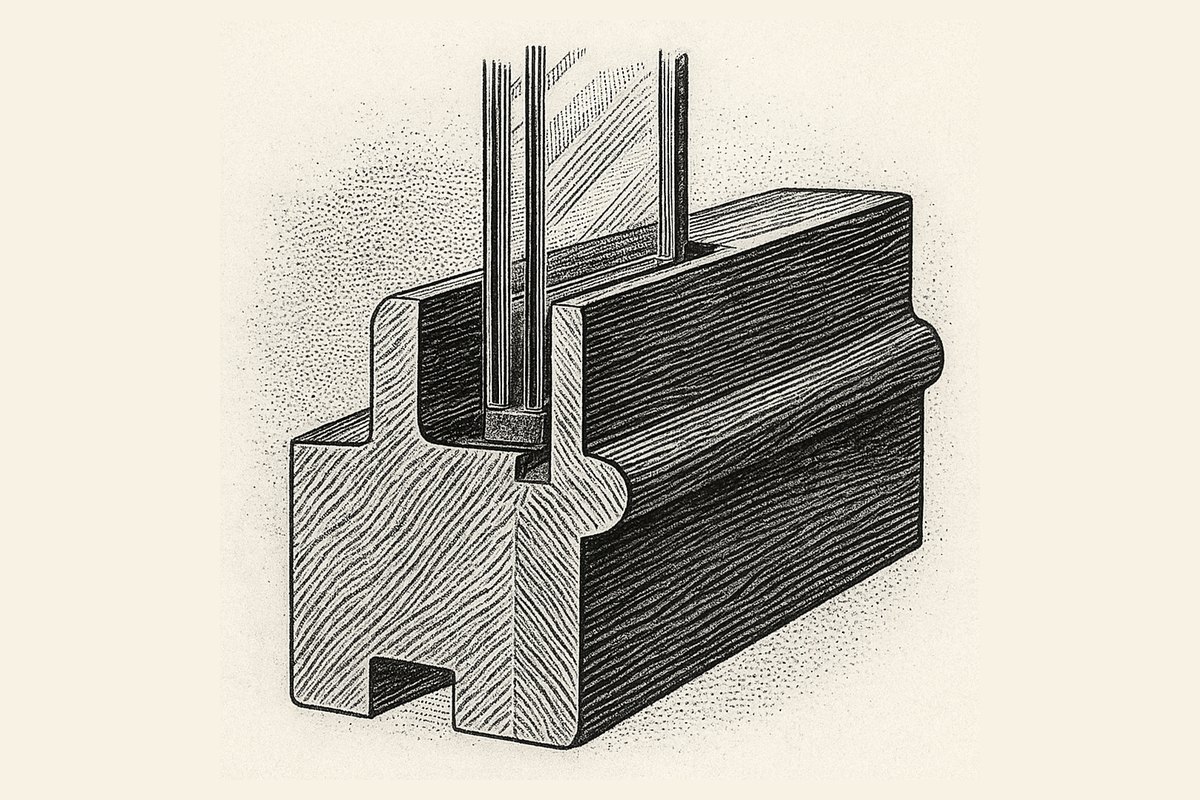
A slim unit is not a pane of glass. It is a sealed assembly whose perimeter seal has to be seated, kept out of standing water and kept away from anything that attacks it. That seal needs somewhere to sit.
Slimlite is the specification most London joiners meet, so take theirs as the example. Every cavity width they make carries a 5mm perimeter seal, and they call for a minimum timber rebate depth of 7mm and a minimum rebate width of 19mm. A typical Victorian sash stile is about 45mm thick with a rebate 10mm to 12mm deep, so on a two-over-two, or any sash without bars, you almost always have the room. They also state that the 5mm sightline is what allows a unit into the rebate of a glazing bar as slim as 17mm. Treat that as the manufacturer's floor, not a comfortable working number.
Glazing bars are where these jobs come apart. A fine Georgian bar gives up rebate on both faces, and once two units are seated in it there is very little section left holding them. This is exactly where you find slim units glazed with a seal too shallow to survive, because the fitter had nowhere else to go.
Ten minutes with a rule tells you most of what you need:
- Measure a glazing bar across its face from the inside, pane to pane. Around 20mm and you are already close to the makers' 17mm floor, with nothing in hand.
- Measure the putty fillet outside, from the glass to the outer arris. That is close enough to your rebate width. Under 19mm and a standard slim unit has no proper seat.
- Press a bradawl into the bottom rail either side of the glazing line, and into the ends of the cill. Soft timber means joinery first. Reglazing a sash that needs rebuilding is money spent twice.
- Push the bottom sash up to shoulder height and let go. If it creeps down with the original 3mm glass in it, the balance is already out, and you are about to treble the glass weight.
- Look along the glass in raking light. Ripple, bloom and a wandering reflection mean cylinder or drawn glass. In a listed building that usually ends the conversation.
Why the cavity has to be that thin, and what thinness costs
A conventional sealed unit runs 24mm to 28mm overall: 4mm glass, a 16mm or 20mm spacer, 4mm glass. Nothing in a Victorian sash will take it. Slim units solve the problem the only way open to them, by collapsing the cavity. A typical heritage make-up is a 4mm outer pane, a gas gap of 4mm, 5mm or 6.5mm, and a 4mm inner pane with a low-emissivity coating facing into that gap, so 12mm to 14.5mm overall. Across the market the slim-profile products sit in a band of roughly 10mm to 16mm.
The catch is that a cavity has an optimum width for whatever gas is in it, and every slim unit sits far below it. The Historic Scotland research on slim-profile glazing puts that optimum at about 16mm for air, 15mm for argon, 11mm for krypton and 8mm for xenon. A 6.5mm gap is below optimum even for xenon, the densest gas anyone fills with. Below the optimum you are no longer suppressing convection; you are conducting straight across the gas, and the only lever left is which gas you buy. That is why heritage units get krypton and xenon at prices argon never approaches, and why no slim unit will behave like a 20mm one.
What they measure once they are in a wall
This is the part worth knowing before you compare quotes. Historic Scotland had ten slim-glazed sashes monitored in occupied Edinburgh flats and measured the centre-of-pane U-value in situ, rather than in a laboratory.
| Unit, as monitored in occupied flats | Fill | Measured centre-pane U-value |
|---|---|---|
| Slimlite | air | 2.8 W/m²K |
| Supalite, in new sashes | argon | 2.8 W/m²K |
| Histoglass D11 | krypton | 2.7 W/m²K |
| Histoglass D10, hand-drawn outer | krypton | 2.3 W/m²K |
| Slimlite | xenon and krypton | 2.3 W/m²K |
| Sashworks, in new sashes | argon | 2.0 W/m²K |
| Slenderglaze | xenon and krypton | 1.7 W/m²K |
| Pilkington energiKare Legacy | vacuum | 1.0 W/m²K |
Single glazing measures about 5.5 W/m²K on the same basis, so every one of these is a real improvement. But the spread is wide, uncertainty on most readings was only five to seven per cent, and the researchers' plain conclusion was that manufacturers' specifications generally overstate what a unit does in a building. The vacuum unit and the Slenderglaze were the exceptions.
Separate laboratory work for the same body, on a single sash and case window in an environmental chamber, gave a slim low-e unit 1.9 W/m²K and a 55% cut in heat loss through the glazing. Both figures are honest; they answer different questions. Before comparing two quotes, ask which gas, which cavity width, and whether the number in front of you is a centre-pane specification, a measured result or a whole-window figure. Our guide to what window U-values actually measure explains why the whole-window one is always worse.
In that same laboratory programme, low-emissivity secondary glazing beat slim double glazing outright, and closed timber shutters were not far behind. Slim units win on being invisible and permanent, not on watts. If cost per degree of comfort is your test, weigh it against secondary glazing before you commit.
Sightline: what 5mm buys, and what it spends
Sightline is the depth of visible edge seal, the dark band between the putty line and where the glass goes clear. On a standard unit it is 8mm to 10mm. Heritage units are built to about 5mm so the glass reads as a single sheet from the pavement, and on a period elevation that difference is the whole point.
It is not free. The band you can see is the seal itself, so narrowing it means less sealant holding gas in and water vapour out, and less material means less margin. That is the central compromise in the whole product category, and it is fair to put to a supplier directly: what sightline are you quoting, and what depth of seal is left behind it?
One optical point works firmly in these units' favour. Because the panes sit close together you do not get the doubled, offset reflection that makes a 24mm unit read wrong on a Victorian front. With low sun across the elevation a slim unit looks far closer to old glass, though never like cylinder or drawn glass, which has movement in it that flat float cannot imitate.
Roughly three times the weight of glass
Glass weighs about 2.5 kg per square metre per millimetre of thickness, so your original 3mm glass is 7.5 kg/m² and a 4-6-4 slim unit is about 20 kg/m² once you add spacer and sealant. On a modest sash with 0.5m² of glazing that is 4kg becoming 10kg. On a large ground-floor sash with 1.2m² it is 9kg becoming 24kg.
Three things follow, and a complete quote addresses all three:
- The weights have to change. Cast iron runs about 7.2 g/cm³ and lead about 11.3 g/cm³, so lead gives you half as much again in the same pocket. On a heavy retrofit lead is often the only way to get the mass into a Victorian box at all. This is why working out the right sash weights is part of a glazing job, not an afterthought to it.
- The cord has to be rated for it. Waxed cotton is sold against a maximum sash weight, and that rating covers the whole sash carried on its pair of cords, not each cord separately: roughly 30kg for 6mm, 40kg for 7mm and 50kg for 8mm. That large sash at about 14kg with its original glass comes back nearer 29kg reglazed, which is past 6mm and into 8mm territory. The cord is also flexing over the pulley wheel under far more load every time the window runs. Go up a size while the sashes are out.
- The joints get tested. A hundred-year-old mortice and tenon at the bottom corner is suddenly carrying half again its design load, and corners that were merely loose start to open. Any competent installer will re-wedge or re-glue them before the glass goes in.
If a quote for slim units in existing sashes says nothing about weights, cords and pulleys, it is not a complete quote. Reglazing without rebalancing gives you a window that will not stay up, or one that runs away from you when you let go, and the extra load finds the weakest joint inside a couple of seasons.
Bedding it so it survives, and what the guarantee really covers
This is the least visible part of the job and the one most often got wrong. Do not bed a sealed unit in linseed oil putty. The oil attacks the polysulphide and butyl in the edge seal, and unit makers say so in their own glazing instructions. The unit looks perfect the day it is finished and mists somewhere between year three and year seven, with nothing to be done short of replacing the glass.
What the makers specify instead is a compatible non-oil system throughout: the unit seated on glazing packers so its weight bears on the rebate rather than the corners of the timber, back-bedded and perimeter-sealed in a neutral-cure silicone or an MS polymer, then faced with a quick-drying heritage compound run to the rebate. Repair Care's Dry Seal MP is the one most often reached for on London heritage work and is listed as suitable for slim units. The materials and their working lives are compared in our article on linseed and modern glazing compounds. If you ask what goes behind the glass and the answer is "putty", ask again.
The rebate also has to shed water. A unit standing in a puddle at the bottom rail fails whatever the seal depth, so bottom rebates need to drain and the paint system needs keeping up. Almost every guarantee is conditional on both.
On guarantees, five to ten years is the range across the trade, with ten fairly common on the better-known units. A conventional 24mm unit with a full-depth seal will usually go twenty years or more, and the shorter warranty is the market's own honest signal about a shallower seal. Slim units are made to BS EN 1279, covering moisture penetration and gas leakage, but certification does not by itself tell you the narrow-cavity, reduced-sightline version you are buying was the configuration tested. Read the terms, and read what voids them.
Consent, and why the Building Regulations are not your obstacle
People worry about Part L and under-worry about the conservation officer. It should be the other way round.
Approved Document L pins its standards to what it calls a controlled fitting, and defines that as the entire window including the frame. Replacing glazing, or a window in its existing frame, is explicitly not providing a controlled fitting and does not have to meet the energy efficiency requirements. So slim units going into sashes you already own have no U-value to hit and nothing for FENSA to certify. Take the whole window out and you are in different territory: 1.4 W/m²K, or Window Energy Rating Band B. There is a route out where character genuinely prevents compliance, being a centre-pane U-value no worse than 1.2 W/m²K, or single glazing with low-emissivity secondary glazing behind it. Read against the measured figures above, that is not a low bar for a slim unit.
Listed building consent is the real gate. Changing the glazing in a historic window is likely to need it, because the glass and the way it is set are part of what is protected. Historic England's position has softened over the last decade, and slim-profile or vacuum units can be acceptable where frames of interest are kept, where no historic glass survives and where the extra weight can be accommodated. That last condition does a great deal of work. If you have cylinder glass in the sashes, expect a refusal and expect it to be the right call; our article on what conservation officers will and won't approve covers how those applications run. In a conservation area it turns instead on whether an Article 4 direction has removed permitted development rights for windows. Plenty of London boroughs have one, they vary street by street, and there is no national answer. Ask the borough before you order glass.
Where this is the right answer
Slim units earn their money in a room you use every evening, in sashes with sound timber and no fine bars, where the glass is plain float and you want the upgrade permanent and invisible. They do not earn it in a spare bedroom, in a sash with a soft bottom rail, or in a window with original glass in it.
If your bars are too fine, look at vacuum glazing, which is thinner again and will sometimes go where a slim unit will not. And if you have not draught-proofed yet, do that first and live with it through a winter. It is the cheapest large improvement available on a sash window, it changes how a room feels more than any U-value suggests, and it closes off none of your later options, which is why our draught-proofing work is usually the first thing we recommend.
When the glass is the right answer, our double glazing work on period sashes takes survey, unit specification, rebalancing and glazing as one job rather than three, and our sash window repair service covers every London borough.
Need this doing? We handle double glazing for sash windows across London — see our sash window repair service or request a free estimate.