
Sash Window Locks: Fitch Fasteners, Brighton Bolts and Stops
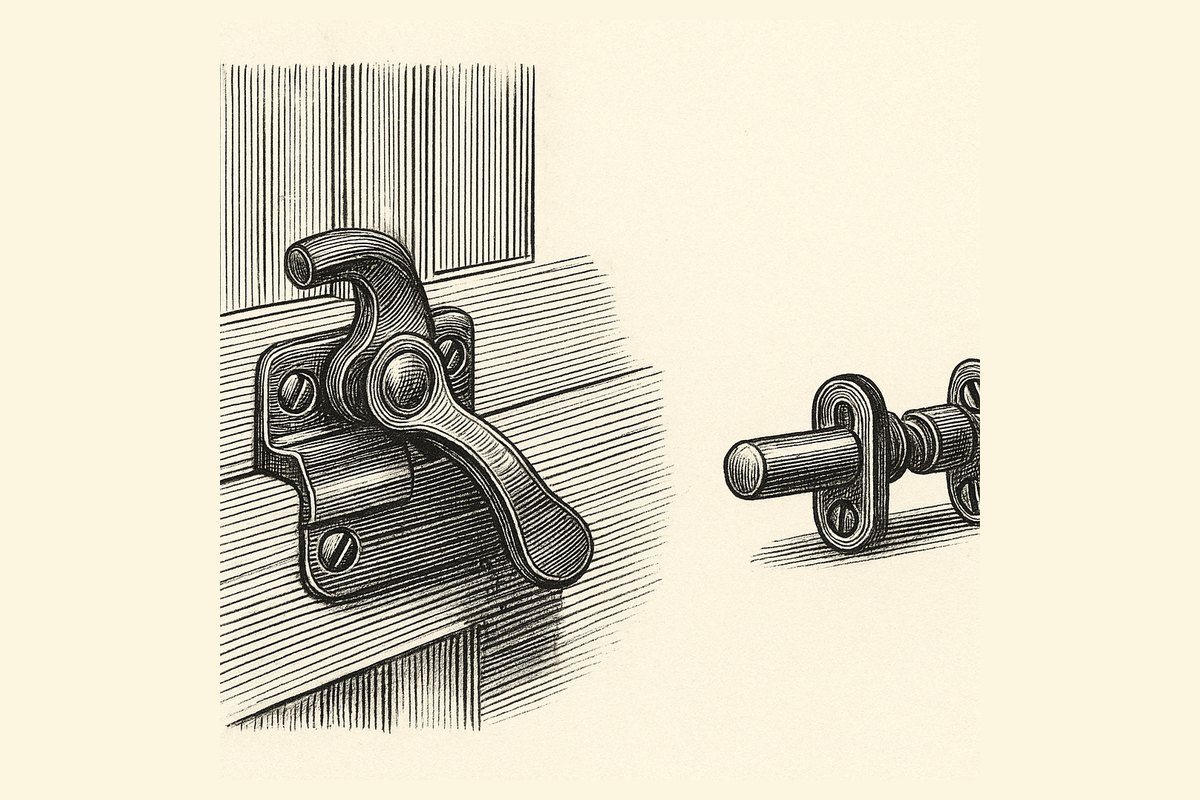
The fastener on a London sash window has one job that most people assume it does and it usually does not: keep somebody out. A standard fitch fastener holds two sashes together and stops them rattling. It is not a lock. On a ground-floor window it can be opened from outside in about eight seconds by anyone with a paint scraper and no scruples.
That does not mean your windows are a problem. It means the fastener is the wrong thing to be judging them by. Here is what each type of sash window lock actually does, how each one is beaten, and what is worth fitting on a period window.
How a sash window is really opened from outside
Three methods, in descending order of how often we see the evidence when we take a window apart.
Slipping the fastener. The gap between the two meeting rails is a few millimetres. Slide a thin blade or a strip of steel up through it and you can catch the arm of a non-locking fitch fastener and flick it open without a mark on the timber. This is the classic sash window entry and it is silent. Any fastener that pivots freely is vulnerable to it.
Levering the bottom rail. A short jemmy under the bottom rail, a body's weight on it, and the lower sash lifts. It is the fastener's fixing screws that fail, not the fastener — they are typically 25mm or shorter, driven into the softwood meeting rail, and they pull out of the grain as a group. Loud, quick, and it leaves a crescent bruise on the cill that any joiner recognises.
Taking the glass out. Old linseed putty on a neglected window can be picked out with a knife, the sprigs pulled, and the pane lifted whole. Slow but very quiet, and it defeats every lock on the window because the intruder never touches them. It is rare on a street elevation and less rare on a basement lightwell or a rear extension roof.
Two things follow. First, the fastener matters most against method one, and screw depth and timber condition matter most against method two. Second, the windows worth spending money on are the accessible ones — ground floor, basement, anything reachable from a flat roof, a bin store, a balcony or a solid drainpipe. A second-floor sash on a terrace front is not where anybody starts.
The fasteners, and what each is actually worth
| Type | How it works | Resists blade attack | Notes |
|---|---|---|---|
| Fitch fastener | Cam-action arm sweeps over a keep and draws the meeting rails together | No, unless the keyed version | The default. Good at pulling the sashes tight, poor as security |
| Locking fitch | As above with a small keyed or push-button cylinder in the arm | Yes | Same look, same fit, straightforward upgrade |
| Brighton fastener | Threaded bolt turned through the inner meeting rail into a socket on the outer | Partly | Older pattern. Adjustable, so it takes up shrinkage. Slow to open |
| Claw or quadrant fastener | Hooked arm pulls the rails together | No | Decorative, weakest of the group |
| Dual screw (sash screw) | Splined-key bolt passes right through the inner meeting rail into a barrel in the outer | Yes | Cheap and genuinely strong. Ugly and hard on the timber |
| Sash stop | Keyed bolt in the upper sash stile blocks the lower sash's travel | Yes | The only one that secures a window left open for ventilation |
The fitch fastener is what is on most London sashes and it deserves its place. The cam action does something useful: as the arm closes it pulls the two meeting rails together, taking up the shrinkage that makes an old sash rattle and closing the draught path at the middle of the window. Replace it and you lose that. The locking versions keep the same cam and add a small cylinder or a push-button in the arm, so you get the tightening action and the security in one fitting. On an accessible window this is the single cheapest worthwhile change.
The Brighton fastener — the screw-down pattern with a knurled knob and a threaded bolt — predates the fitch and turns up on Georgian and early Victorian windows. It is adjustable, which is its real advantage: as the sashes shrink over the decades you simply wind it further in. It also cannot be flicked open with a blade, though a determined person can sometimes turn the bolt through the gap. Over-tightening one will crush the meeting rail bevels and eventually split the rail, so it wants to be nipped up, not cranked.
Dual screws are the brutal option and they work. A bolt passes through the inner meeting rail into a threaded barrel in the outer one, so the two sashes are pinned together through their thickness. Nothing you can slide through the gap will help. The downsides are real: the hole through the rail has to be drilled dead square or the bolt binds, the barrel eventually wallows out in soft timber, and if the sashes move relative to each other seasonally the bolt will not line up in January even though it did in July. Fit them in pairs on wide windows, and expect to re-drill the barrel once in a couple of decades.
Sash stops: the only lock for a window you want left open
This is the fitting most London homeowners have never heard of and the one that solves the actual problem. A sash stop is a small brass barrel let into the face of the upper sash stile, containing a bolt that a key winds out to project into the path of the lower sash. Wind it out and the lower sash can only rise until its meeting rail meets the bolt — set them at around 100mm and you have a ventilation gap too narrow to climb through, with the window physically stopped from opening further.
They are fitted in pairs, one each side, and on a window over about 900mm wide you want both or the sash can be racked. The bolt should land in the sash stile, not in the glazing rebate, and the barrel needs to sit in sound timber at least 20mm thick behind it.
Set two positions if you like: one bolt hole for the closed position, giving you a lock in its own right, and one about 100mm up for secure ventilation. That is a bedroom on a warm night without leaving the house open, and it is why we fit more of these than any other item of window hardware.
No lock is stronger than the timber it is screwed into. If the meeting rail or the sash stile is soft, a security upgrade is money thrown at a rotten window. Press both with a thumbnail before you buy anything. Where the timber has gone, the repair comes first and the ironmongery second.
Fitting into a meeting rail that is barely 45mm thick
This is where DIY security jobs go wrong. A Victorian sash is typically 45mm to 50mm thick front to back, and the meeting rail is that same thickness with a bevel worked across it and a glazing rebate cut into one face. There is not much meat there.
- Drill pilot holes, always. Old Baltic redwood is dense and resinous, and driving a screw into it dry will split the rail along the grain. A 2mm pilot for a 4mm screw is about right.
- Use the longest screw the rail will take, and no longer. Measure from the face to the back of the rebate and stop short of it. A screw that reaches the glass rebate will crack the pane the first time somebody leans on the sash. On most windows that means around 25mm to 30mm, and you gain more by using four screws in sound timber than two long ones in soft.
- Set the keep before the fastener. Close the window, mark the keep from the closed position, and check the cam still has to work slightly to close. If the fastener falls shut with no resistance it is not pulling the rails together and it will rattle.
- Check the sashes still slide before you put the tools away. A stop bolt fitted a millimetre proud of the stile face will score the lower sash every time it passes.
- Match the metal. Polished brass, satin chrome and unlacquered brass all age differently. Unlacquered brass will dull to a soft brown in a couple of years and is the honest choice on a period window.
If the fastener will not pull the rails tight no matter where you set the keep, the sashes have shrunk apart and the answer is not a bigger fastener. It is taking up the gap, which is what our guide to stopping a sash window rattling is about, and what a proper draught-proofing overhaul does as a side effect.
The glass is the part nobody upgrades
You can put four locks on a window and leave a 4mm sheet of float glass in it. If somebody is prepared to make noise, the glass is the way in, and on a basement or rear window nobody is listening anyway.
The upgrade is laminated glass. A 6.4mm laminate is two 3mm sheets bonded either side of a 0.38mm plastic interlayer. Break it and it stays in the frame as a cracked sheet — you cannot punch through it and reach a fastener, and getting a body-sized hole in it takes sustained, obvious effort. It also drops traffic noise noticeably, which on a London main road is often the reason people fit it in the first place, as covered in our piece on cutting traffic noise through sash windows.
There is one mechanical consequence. Float glass weighs roughly 2.5 kg per square metre per millimetre of thickness, so 4mm float is about 10 kg/m² while 6.4mm laminate is closer to 16. On a sash with 0.6 m² of glass that is around 3.5 kg added, which puts the counterweights out and means re-weighting, and usually re-cording while the window is apart. Any glazier who quotes laminate for a box sash without mentioning the weights has not thought about it. The same applies if you are considering heritage or restoration glass at the same time.
Do not lock yourself in
Locks on windows cut both ways. A key-operated fastener on a first-floor bedroom window is also a barrier to getting out of that room in a fire, and to a firefighter getting in.
Approved Document B sets escape window requirements for new and replacement windows in certain rooms — broadly a minimum clear openable area of around a third of a square metre, with no dimension much under 450mm, and the bottom of the opening within a workable height above floor level. The exact figures and whether they apply to your job are a matter for building control or your installer, and it is worth asking the question directly rather than assuming. Our guide to building regulations for windows sets out where the replacement rules bite and where repair sits outside them.
The practical rule is simpler. Keep one key per floor, on a hook near the window but not within arm's reach of the glass and not visible from outside. Everyone in the house should know where it is. A key hidden so well that nobody can find it at three in the morning is worse than no lock at all.
What insurers ask for, and what the regulations do not
Most household policies condition cover on locks for "accessible" windows, usually meaning ground floor, basement, and anything reachable from a flat roof, extension, balcony or similar. The wording varies between insurers and the definition of accessible varies more. Read your own schedule rather than a summary of somebody else's — the requirement is nearly always "key-operated locks", which a standard fitch fastener does not satisfy and a locking fitch, dual screw or sash stop does.
On the regulatory side, there is less to worry about than people expect. Approved Document Q, which deals with security in dwellings, applies only to new dwellings. It does not impose a security standard on windows in an existing house, and PAS 24, the enhanced-security test standard, applies to manufactured window products rather than to an original box sash that was made in a workshop in 1880. Nobody is going to fail your period windows. The decision is yours and it is an insurance and common-sense one.
A sensible specification for a London sash
For an accessible window: a locking fitch fastener at the meeting rail, a pair of key-operated sash stops set for secure ventilation, sound timber under both, and laminated glass if the window is at the back, at basement level, or on a noisy road. That is a couple of hours of a joiner's time per window and it addresses all three attack methods rather than one.
For an upper-floor window on a street frontage: a standard fitch in good order, correctly set so it pulls the rails tight, and nothing else. Spending on security up there is spending in the wrong place. If those windows bother you, they almost certainly bother you for draught rather than burglary, and a draught-proofing overhaul is the better use of the money.
Before you order anything, open each window fully and check the meeting rail and stiles for soft timber, because that decides whether this is an ironmongery job or a repair job. Our London sash window repair service handles both together, which is usually the cheaper way round — the window has to come apart for the timber work anyway, and fitting the hardware while it is open costs almost nothing extra.
We repair and restore timber sash windows across London — see our sash window repair service or request a free estimate.